
From Frosted to Flawless — Window Cleaning in Cooloongup
Location: Cooloongup
There’s a particular type of glass contamination that doesn’t announce itself the way a dirty splash mark or handprint does. It builds slowly and uniformly — a fine, dense haze that creeps across the entire surface until one day the window that used to look out onto the street now barely lets the light through. No single event caused it. No storm, no accident. Just months of fine dust settling, bore water overspray drying, and the quiet accumulation of everything the Perth climate deposits on exposed glass.
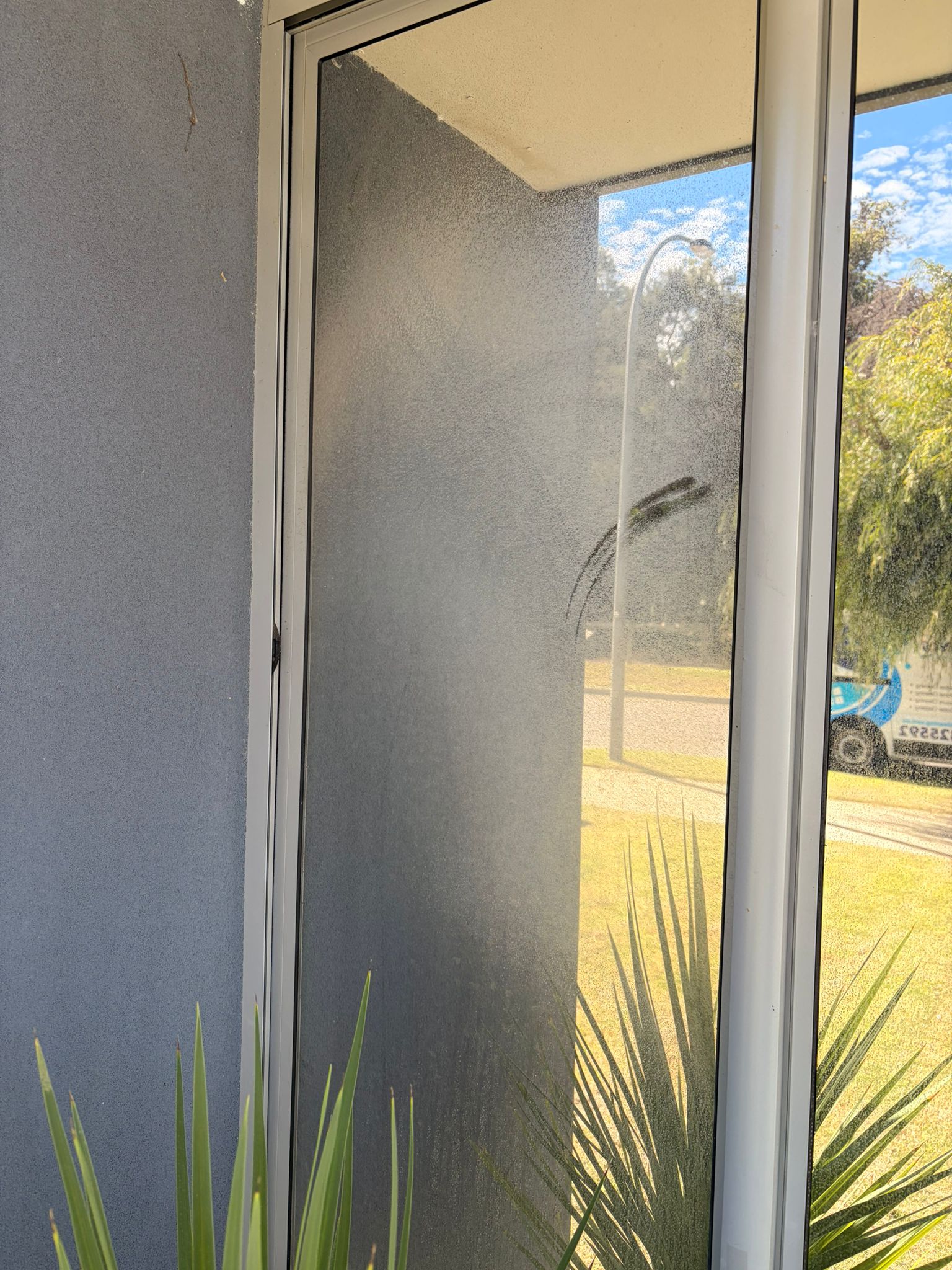
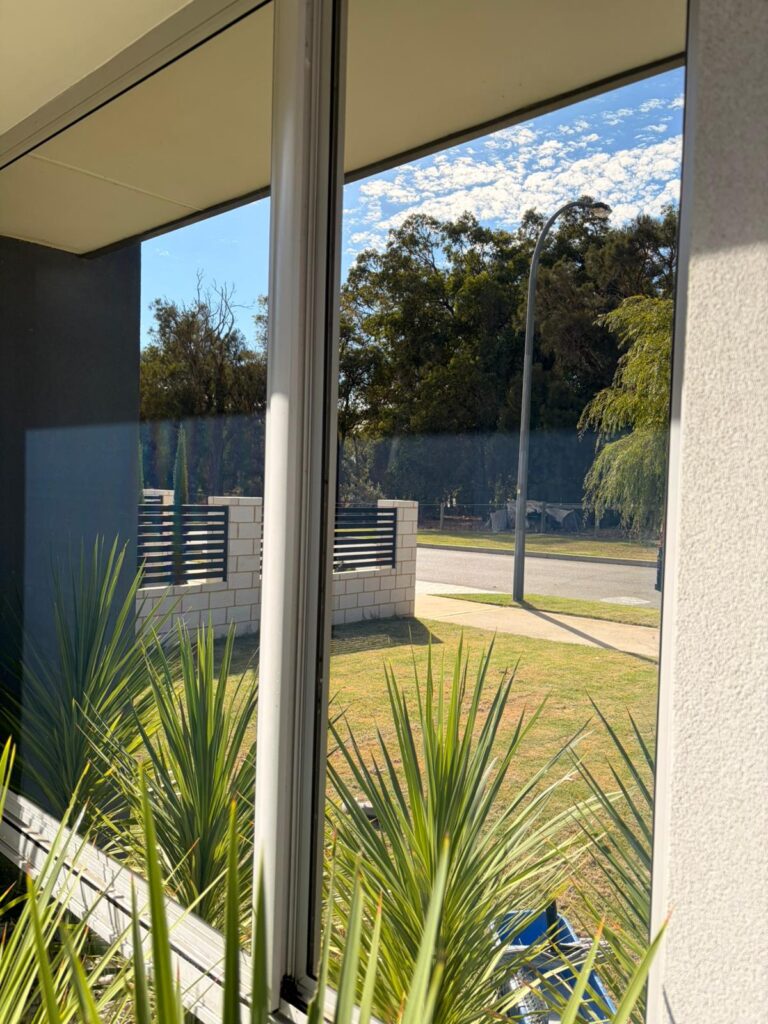
That’s exactly what we were dealing with at this Cooloongup property. The before photo shows a corner window panel so uniformly hazed it reads almost as frosted glass — you can make out the street lamp outside and faint shapes beyond, but the transparency that the window was installed to provide has completely gone. The after photo shows the same corner configuration following our clean: a blue WA sky, crisp cloud detail, mature street trees, the front garden wall and street all visible with perfect clarity through both panels.
Reading the Before Photo
The before shot is a close-up of a corner window — two panels meeting at a right angle on the front façade of a modern rendered home. The white-framed aluminium surrounds a pane that has taken on a consistent, fine-grained grey haze across almost its entire surface.
This texture is characteristic of two overlapping contamination types that are both extremely common in Cooloongup:
Fine atmospheric dust accumulation. Cooloongup sits in established Rockingham, surrounded by a mix of older residential streets, nearby light industrial corridors, and the vehicle traffic that comes with a dense suburban area. Fine particulate matter — road dust, brake dust, tyre residue, general airborne grit — settles on horizontal and vertical surfaces alike. On glass, it bonds with surface moisture and forms a uniform grey coating that becomes progressively harder to remove as it compresses under its own weight over time.
Mineral haze from bore water reticulation. The fine spotting visible across the surface — distinct from pure dust in the way it creates a slightly cratered or textured appearance at close range — is the signature of bore water evaporation. The groundwater in Rockingham and Cooloongup carries elevated dissolved mineral content. Reticulation spray reaches glass surfaces, dries in the sun, and deposits a thin mineral film with each cycle. Over a season, those films stack into the dense haze visible in the before photo.
What makes this type of contamination particularly stubborn is that it isn’t sitting loosely on the surface — it’s chemically bonded to the glass through the repeated wet-dry cycles. A household glass cleaner and a cloth will spread it rather than remove it. Professional treatment is required to break down the bond and lift the deposits cleanly.
You can also spot, in the right-hand panel of the before photo, the reflection of the Baldivis Window Cleaning van parked out front — a detail that makes the contrast with the left panel even clearer. One panel catching the reflection through partial contamination, the other almost completely opaque.
Why Cooloongup Windows Build Up This Type of Haze
Cooloongup is one of Rockingham’s older established suburbs, and the housing stock here tends to have a different contamination profile to the newer estates further south. A few factors specific to the area drive what we consistently see on glass here:
Older reticulation systems with higher overspray. Many Cooloongup properties have reticulation systems that have been in place for decades, and older sprinkler heads tend to produce a broader, less targeted spray pattern than modern installations. More overspray on glass means faster mineral deposit accumulation — and in bore-heavy areas like this, that means the haze builds up quickly.
Street-facing windows in established tree canopy areas. Cooloongup has significant established street tree coverage, which is a positive thing for liveability but contributes to glass contamination in a specific way: organic matter from trees — pollen, fine debris, fungal spores — settles on glass and bonds with dust and moisture. On street-facing windows with limited architectural overhang, this accumulates year-round rather than seasonally.
Proximity to Rockingham’s light industrial and commercial zones. The suburb borders areas with higher vehicle and commercial traffic, and the fine particulate matter generated by that activity is carried on the prevailing winds. It’s the same pattern we see in Kwinana, where industrial fallout is even more pronounced, and in Rockingham generally — fine airborne contamination that settles uniformly on glass surfaces facing the street.
How We Cleaned It
The contamination profile on this job — combined mineral haze and compacted atmospheric dust — called for a deliberate multi-stage approach rather than a straight wash-and-squeegee.
Frame and sill preparation first. Before any solution touches the glass, the frames and sill channels are cleared of accumulated dust and debris. White powder-coat frames like those on this property hold fine dust in the surface texture, and if that isn’t addressed before the glass wash begins, it gets dragged across the freshly cleaned panes during the work.
Pre-treatment for bonded contamination. The mineral haze and compacted dust required a pre-soak treatment to begin breaking the bond between the deposits and the glass surface. Professional-grade solutions designed for this contamination type work differently from standard glass cleaners — they’re formulated to chemically dissolve mineral deposits and soften compacted dust rather than simply attempting to wipe them off.
Full wash and S-pattern squeegee technique. Working top to bottom across each pane in overlapping strokes, ensuring no dirty solution runs back across already-cleaned sections. On corner configurations like this property, the meeting point between the two panels requires particular care — water management at the join is where streaking most commonly occurs if the technique isn’t disciplined.
Edge and corner detailing by hand. The junction between glass and frame, and the internal corner between the two panels, are detailed with a chamois after the main squeegee pass. This is the step that determines whether the final result is streak-free right to the edges — which it needs to be for the result to look as clean as the after photo shows.
Flyscreen cleaning is included as part of our standard window cleaning service. Screens are removed, cleaned separately, and reinstalled — skipping this step would simply transfer contamination back to the freshly cleaned glass the first time wind pushes the screen against it.
The After: What Clean Glass Does for a Front Façade
The after photo shows the same corner window following the clean. Same angle, same framing, same street scene beyond — but the glass is now completely transparent.
The blue sky and cloud detail visible in the upper portion of the after shot were entirely invisible in the before. The street lamp, the front boundary wall, the mature trees across the road, the front garden plantings — all of it is now sharp and clear through both panels. The white aluminium frames look noticeably cleaner against the grey rendered wall. The whole front elevation of the property reads as well-maintained and cared for in a way that a haze-covered window wall simply doesn’t.
From inside the property, the change is even more tangible. A window hazed with mineral deposits and compacted dust acts almost like a one-way filter — it reduces incoming natural light, flattens the quality of light in the room, and makes a space feel darker and more enclosed than it should. Clean glass restores the full light transmission the window was designed to provide.
Corner Windows: A Note on Why They Accumulate Faster
The corner window configuration on this property is worth a brief note, because it comes up regularly across Cooloongup and the surrounding Rockingham suburbs.
Corner windows — two panels meeting at a right angle — create a low-pressure zone at the internal corner where the panels meet. Airflow that would normally carry dust particles past a single flat surface gets interrupted at the corner, and particles tend to settle into that zone rather than continuing past it. Over time, this means corner windows accumulate contamination faster than equivalent single-panel windows in the same exposure position.
It’s also why the internal corner between the two panels, in the after photo, needs to be perfectly clean — any residual haze or streaking at that point is visually amplified by the geometry of the corner, drawing the eye immediately.
Solar Panels in Cooloongup
If your Cooloongup property has solar panels, the same contamination profile affecting your windows is working on your panels. Fine dust and bore water mineral deposits on solar glass reduce the amount of light reaching the cells, cutting measurable generation output — often significantly in WA conditions.
We’ve covered this in our post on professional solar panel cleaning in Cooloongup. Our solar panel cleaning service uses a deionised water system that leaves panels completely residue-free — no detergent, no spotting, just clean glass that lets maximum light through to the cells. Combining a window clean with a solar clean in a single visit is the most efficient approach.
Keeping on Top of It: Maintenance Frequency for Cooloongup
The contamination on this job had been building for some time — the density and uniformity of the haze indicates extended accumulation rather than a single season’s buildup. A first professional clean after a long gap takes more time and work. A maintenance clean scheduled every six to twelve months, on glass that hasn’t had time to re-contaminate to this level, is quicker and less intensive each time.
The principle is simple: the longer mineral deposits and compacted dust are left on glass, the more deeply they bond to the surface, and the more work is required to remove them. Staying on a regular schedule keeps the glass at a baseline that’s much easier to maintain.
Our guide on exterior maintenance scheduling for WA homeowners has more detail on how to plan ahead across all exterior surfaces for the year.
Serving Cooloongup and the Surrounding Area
We cover Cooloongup as part of our regular run through the Rockingham corridor. Nearby suburbs we regularly service include Rockingham, Kwinana, Waikiki, Safety Bay, Shoalwater, and Port Kennedy.
Exterior window cleaning starts from $99. We’re happy to combine it with solar panel cleaning, pressure washing, or gutter cleaning in a single visit.
Book a Window Clean in Cooloongup
If your front windows look anything like the before photo in this post, it’s worth getting ahead of it before the contamination bonds any deeper. Visit our Cooloongup service page for more information or to request a quote.
We service Cooloongup and 30+ suburbs across Perth’s southern corridor.