
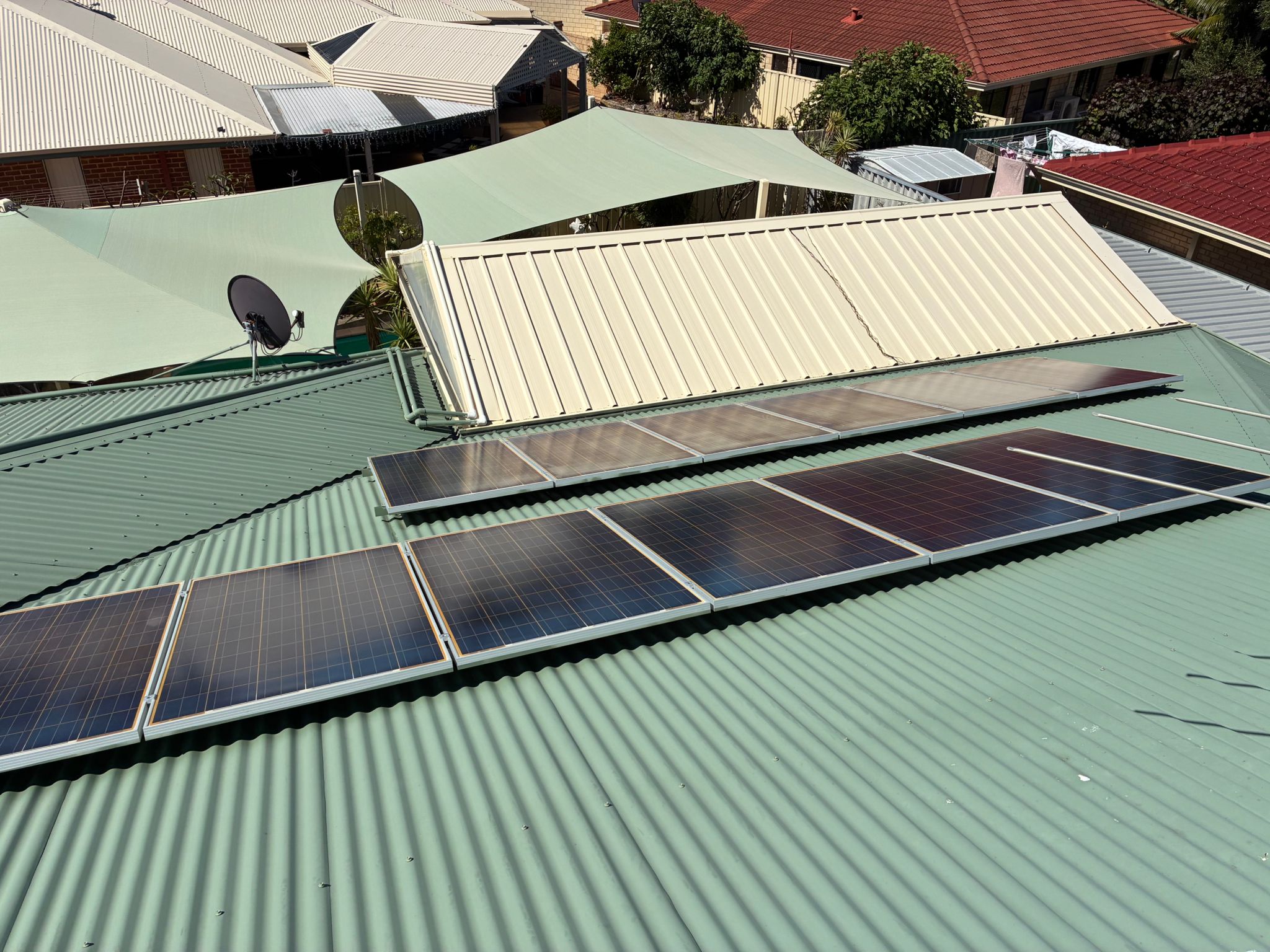
Solar panel cleaning in Bertram - 12 polycrystalline panels across two roof pitches on sage green Colorbond roof
Location: Bertram
Not every solar installation sits in a single neat row on one roof face. As system sizes have grown and homeowners have sought to maximise panel count within the constraints of their roof geometry, split-array configurations — panels distributed across two separate roof pitches — have become increasingly common across Perth’s southern suburbs. Bertram, with its mix of established homes and varied rooflines, has plenty of them.
This job is a good example. Two rows of 6 panels each, mounted on separate pitches of the same property’s roof, totalling 12 panels across the full installation. The panels are older-style polycrystalline units — the type with the characteristic dark blue and purple cell toning and visible internal grid lines that were the standard in residential solar installations for many years. Systems like this one have often been running for a decade or more, quietly generating power, and in many cases quietly losing output to contamination that has never been professionally addressed.
The System: What We Were Working With
The photo shows the two arrays on this Bertram property — both groups of 6 panels visible from above on a distinctive sage green Colorbond roof. The two pitches meet at a ridge running across the centre of the image, with one array on each side.
The polycrystalline panels on this system are visibly older than the monocrystalline black panels that dominate newer installations. The cell structure shows the characteristic blue-purple variation in crystal orientation that gives polycrystalline glass its slightly mottled appearance. These panels are still perfectly functional — polycrystalline technology remains effective and the panels themselves degrade slowly over decades — but they have specific characteristics that affect how contamination presents and how cleaning needs to be approached.
A satellite dish is mounted on the left side of the roof, and the neighbouring properties — with their own rooftops, shade sails, and mature garden vegetation — are visible in the background. This is established Bertram residential, the kind of older suburb where solar systems installed in the early years of Perth’s rooftop solar uptake are now a decade into their operating life.
Why Older Systems in Bertram Need Cleaning Most
There’s a pattern we see consistently across established suburbs like Bertram: solar systems that were installed eight to twelve years ago, during the peak of Perth’s residential solar rollout, that have never had a professional clean. The homeowners know the system is working — the inverter is running, the feed-in credits appear on the bill — but they have no baseline to compare against, and the gradual output decline from contamination has been invisible precisely because it happened so slowly.
A system that loses two or three percent of output per month to contamination doesn’t trigger any alarm. The bill goes up a little, but electricity prices have also gone up, and the two things are hard to separate without careful monitoring. By the time a homeowner notices something is off, the panels may be operating at 70 or 75 percent of their rated capacity — and they’ve been running below peak for years.
Bertram’s specific environmental conditions accelerate this process:
Proximity to Kwinana’s industrial corridor. Bertram sits directly adjacent to Kwinana, one of the most industrially active areas in Perth’s southern suburbs. Particulate fallout from industrial activity, vehicle emissions from heavy transport routes, and the general atmospheric load from a busy industrial zone all contribute contamination that settles on rooftop surfaces throughout the year. For solar panels, this means a background layer of fine industrial particulate accumulating on panel glass continuously — the kind of grime that doesn’t look dramatic in small quantities but builds into a measurable light-blocking film over a full season.
Bore water reticulation mineral deposits. Bertram properties almost universally run bore-fed reticulation. The groundwater in this part of the Kwinana corridor carries elevated dissolved mineral content — calcium, magnesium, and iron — and reticulation overspray reaching the roofline deposits those minerals onto panel glass with each watering cycle. After a full summer of daily reticulation, the cumulative mineral film on panel surfaces is substantial.
Established tree canopy and organic matter. Bertram is an older, established suburb with significant tree cover compared to the newer estates further south. Established trees generate higher pollen loads, organic fine debris, and in some cases bird activity that adds biological contamination to the mix. All of these bond to warm solar glass and resist removal by wind or light rain.
Split-array configuration exposure. With panels on two separate roof pitches, this system has glass facing two different directions, each catching a slightly different wind pattern and contamination source. Both arrays need addressing in a single clean — which is exactly what this job involved.
The Output Case: What a Decade Without Cleaning Costs
For a 12-panel polycrystalline system of the vintage visible in this photo — typically a 2.5 to 3kW installation by modern panel rating equivalents — the output loss from contamination over an extended period without cleaning is significant.
Research on solar panel soiling in Perth conditions consistently shows output losses of 15 to 35 percent for systems that haven’t been cleaned in twelve months or more. For a system that hasn’t been professionally cleaned in several years, losses at the higher end of that range are realistic. On a 3kW system, a 25 percent output reduction is 750W of continuous generation capacity that isn’t reaching the inverter during peak sun hours — across Perth’s 3,200+ annual sunshine hours, that’s a material loss in generation that a single clean begins to recover immediately.
The additional consideration for older polycrystalline systems is that cleaning restores output that the panels are still fully capable of delivering. These panels degrade slowly — typically 0.5 to 0.8 percent per year in rated capacity — so a ten-year-old system is still operating at around 92 to 95 percent of its original rated capacity. The contamination loss is on top of that natural degradation, and unlike panel degradation, contamination loss is entirely recoverable with a professional clean.
Our solar panel cleaning guide for coastal WA covers the evidence behind these figures in detail.
Cleaning a Split-Array System
Split-array installations like this one require slightly different logistics than a single-array system, but the cleaning process itself is identical across both groups of panels.
Deionised water only. Our water-fed brush pole delivers pure deionised water — all dissolved minerals removed — to the panel surface. When the rinse water evaporates, it leaves nothing behind. This is the critical point of difference from tap water, which deposits a fresh mineral film as it dries, and from detergent-based cleaning, which leaves a surfactant residue that attracts airborne particles faster than clean glass. Deionised water is the only rinse method that leaves panel glass genuinely residue-free after cleaning.
Soft brush agitation across both arrays. The brush head works across each panel in turn, loosening and lifting contamination from both the cell surface and the frame channels. For polycrystalline panels, which have a slightly different surface texture to monocrystalline glass, this agitation step is important to ensure contamination is fully lifted before the final rinse rather than redistributed across the surface.
Frame channel cleaning. The aluminium rail frames and panel edge channels on both arrays are cleared of accumulated debris. On an older system like this one, where the frames have had years to collect organic matter and mineral deposits in the channels, this step makes a visible difference to the cleanliness of the installation overall.
Both pitches addressed in a single visit. Split-array systems are cleaned in a single continuous visit — the logistics of moving the equipment between roof pitches are straightforward, and completing both arrays together means the system generates as a whole unit from clean glass rather than having one array performing better than the other.
Ground-based operation. The water-fed pole reaches panels on standard residential rooftops without anyone stepping onto the roof — both safer for the technician and eliminating any risk of damage to the roof sheeting or panel mounting hardware from foot traffic.
After the Clean
Following the clean, all 12 panels across both arrays were left residue-free, with the panel glass fully transparent and the frame channels cleared of accumulated debris. On polycrystalline panels, the visual result of a clean is slightly different to monocrystalline — the characteristic blue-purple cell toning becomes more vivid and uniform once the contamination haze is removed, and the internal cell grid lines are sharper and more defined.
The inverter output improvement on a system like this — older panels, significant contamination period, industrial environment — is typically among the most noticeable we see. Homeowners with monitoring apps often observe the generation change directly in their data within the first full sunny day after the clean.
Other Services at Bertram Properties
While we were at this property for the solar clean, it’s worth noting that Bertram’s industrial proximity and established character mean other exterior surfaces also benefit from regular professional attention.
The same particulate fallout affecting the solar panels is settling on windows and hard surfaces throughout the property. Our window cleaning service addresses the same contamination profile on glass surfaces, and combining both services in a single visit is the most efficient approach. We’ve also done pressure cleaning work in Bertram previously, which gives a sense of the kind of surface contamination that builds up on paving and hard surfaces in this area. Gutter cleaning is another service worth considering on established Bertram properties where leaf and debris accumulation in gutters is ongoing.
Cleaning Frequency for Bertram Solar
Given the industrial proximity and bore water conditions in Bertram, we recommend a professional solar panel clean every six to twelve months for most properties in the suburb. Systems that haven’t been cleaned since installation — particularly those installed during the 2012 to 2016 rooftop solar boom — should be prioritised for a first professional clean regardless of how the inverter numbers look. The output improvement from restoring a never-cleaned older system is often the most dramatic result we achieve on any job.
Our WA homeowners exterior maintenance guide has more detail on scheduling across all exterior surfaces for the year ahead.
Serving Bertram and the Surrounding Area
We cover Bertram as part of our regular run through the Kwinana and Cockburn corridors. Nearby suburbs we regularly service include Kwinana, Cockburn, Atwell, Wellard, Parmelia, and Baldivis.
Solar panel cleaning starts from $89. For split-array systems or larger installations, we provide an accurate quote based on panel count and access. Combining with a window clean or pressure wash on the same visit keeps costs down and covers the full property in one appointment.
Book a Window Clean in Bertram
If your Bertram solar system — whether it’s a newer installation or one of the older polycrystalline systems that have been running for a decade — hasn’t had a professional clean recently, it’s worth booking one. Visit our Bertram service page for more information or to request a quote.
We service Bertram and 30+ suburbs across Perth’s southern corridor.