
When Mineral Spotting Takes Over — Heavy Contamination Window Cleaning in Port Kennedy
Location: Port Kennedy
Some jobs are straightforward. The glass is dusty, a season’s worth of grime has settled on the frames, and a professional clean brings everything back to where it should be. Then there are jobs like this one.
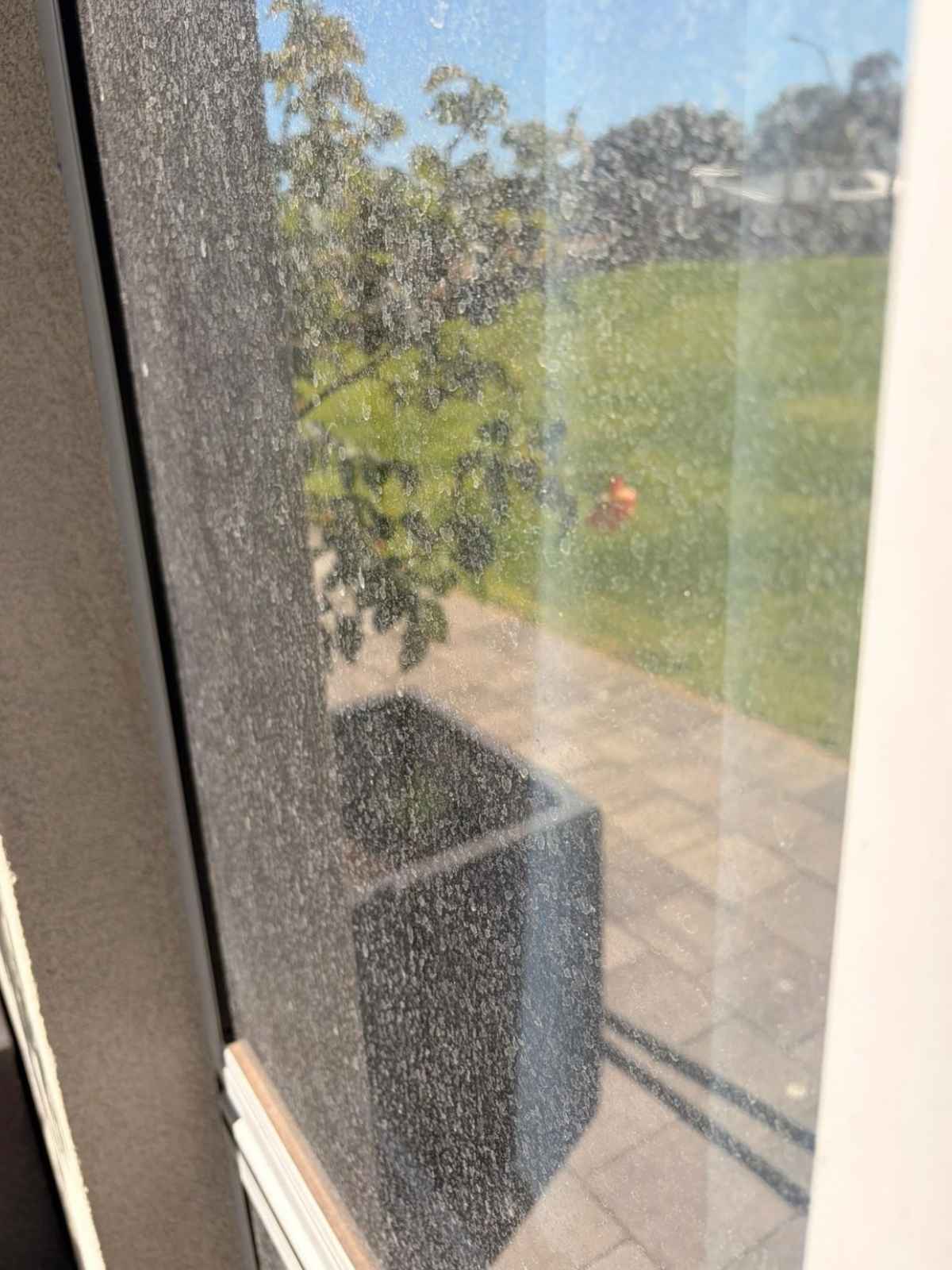
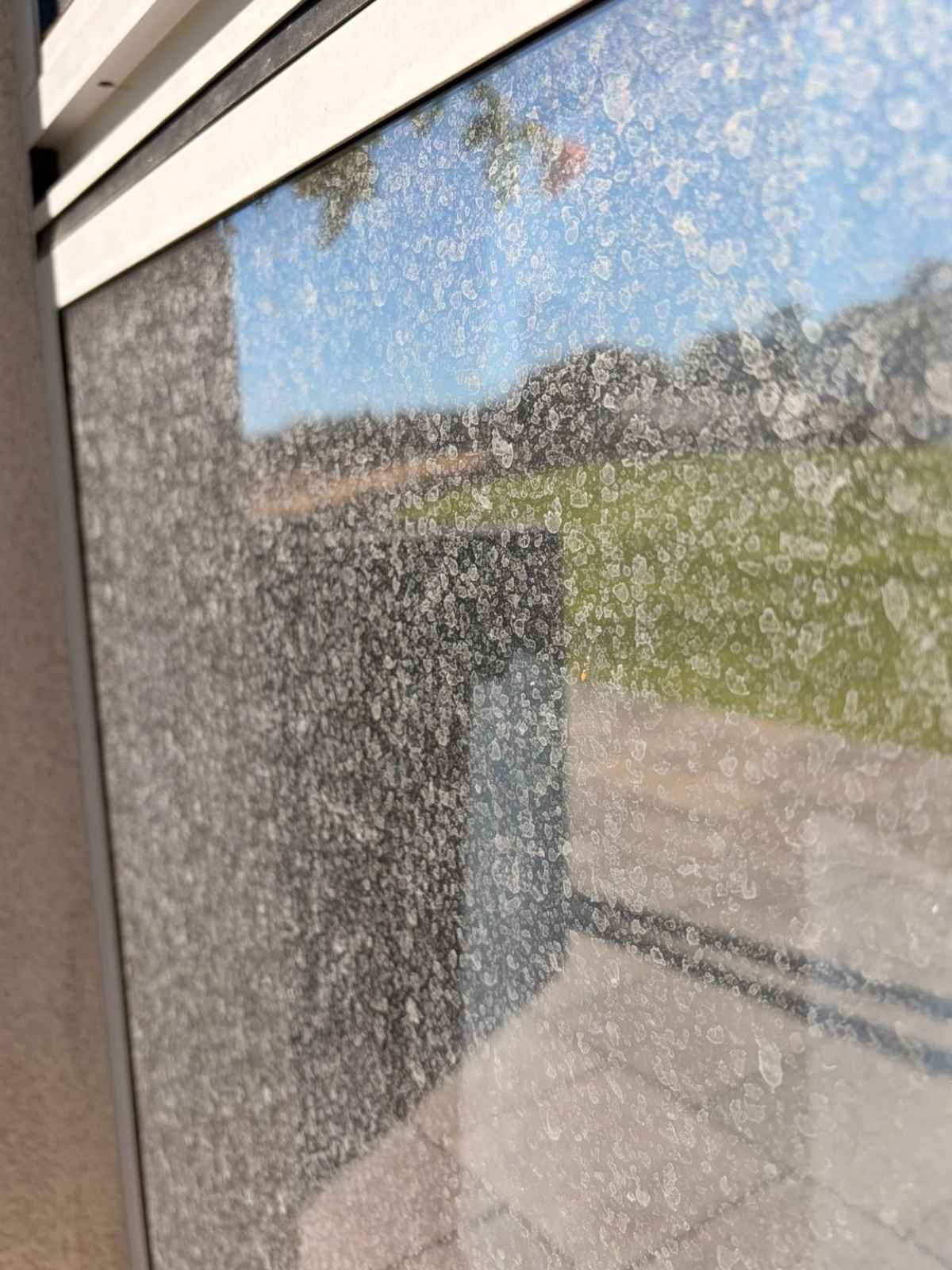
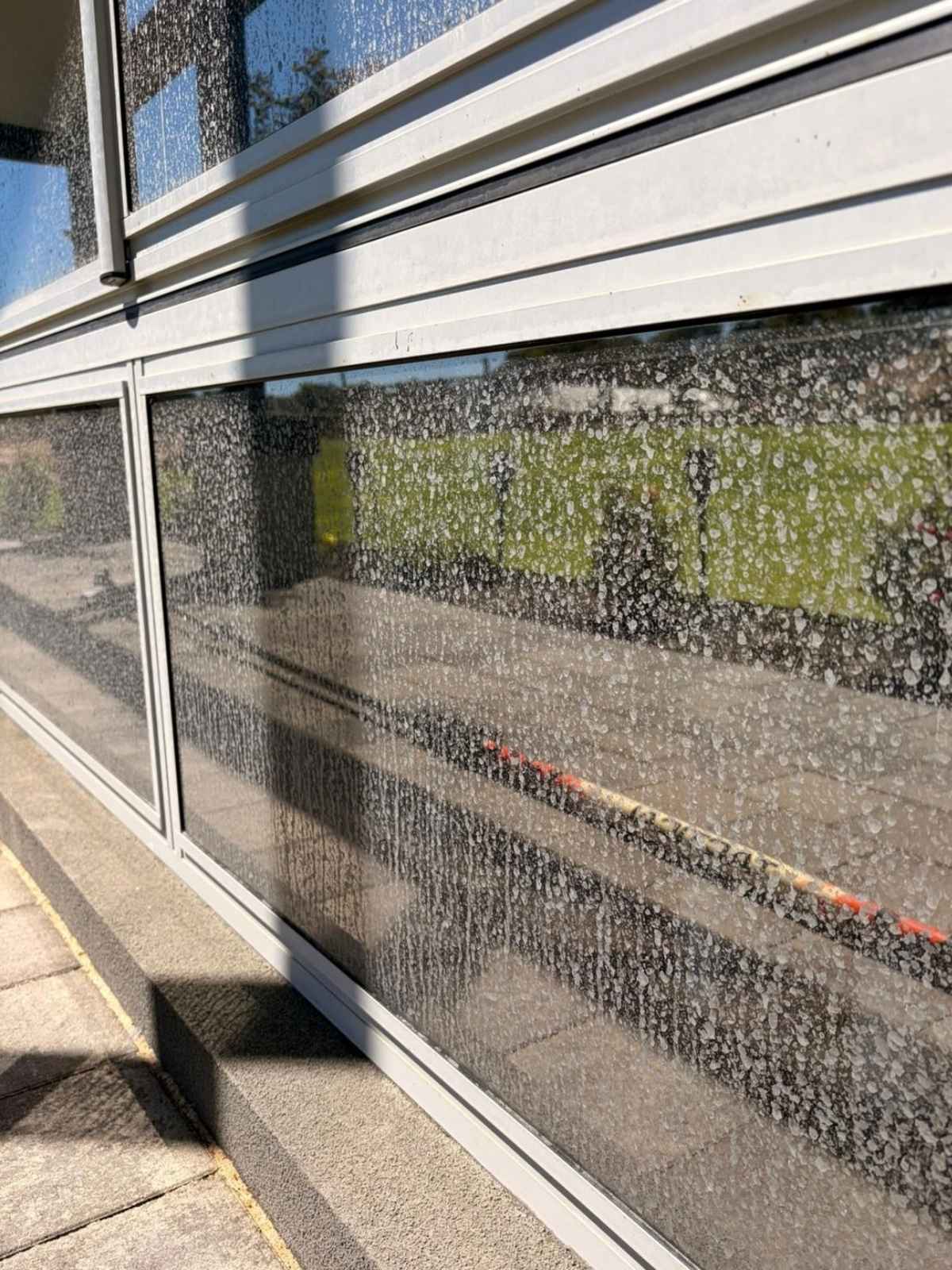
When we arrived at this Port Kennedy property, the windows weren’t just dirty — they were comprehensively coated in one of the heaviest cases of mineral spotting we see in the southern corridor. Three close-up photos tell the story better than any description: thousands of individual calcium and silica deposits covering virtually every centimetre of glass across a large, modern window wall. The kind of contamination that doesn’t wipe off, doesn’t respond to standard cleaning products, and gets progressively harder to remove the longer it’s left untreated.
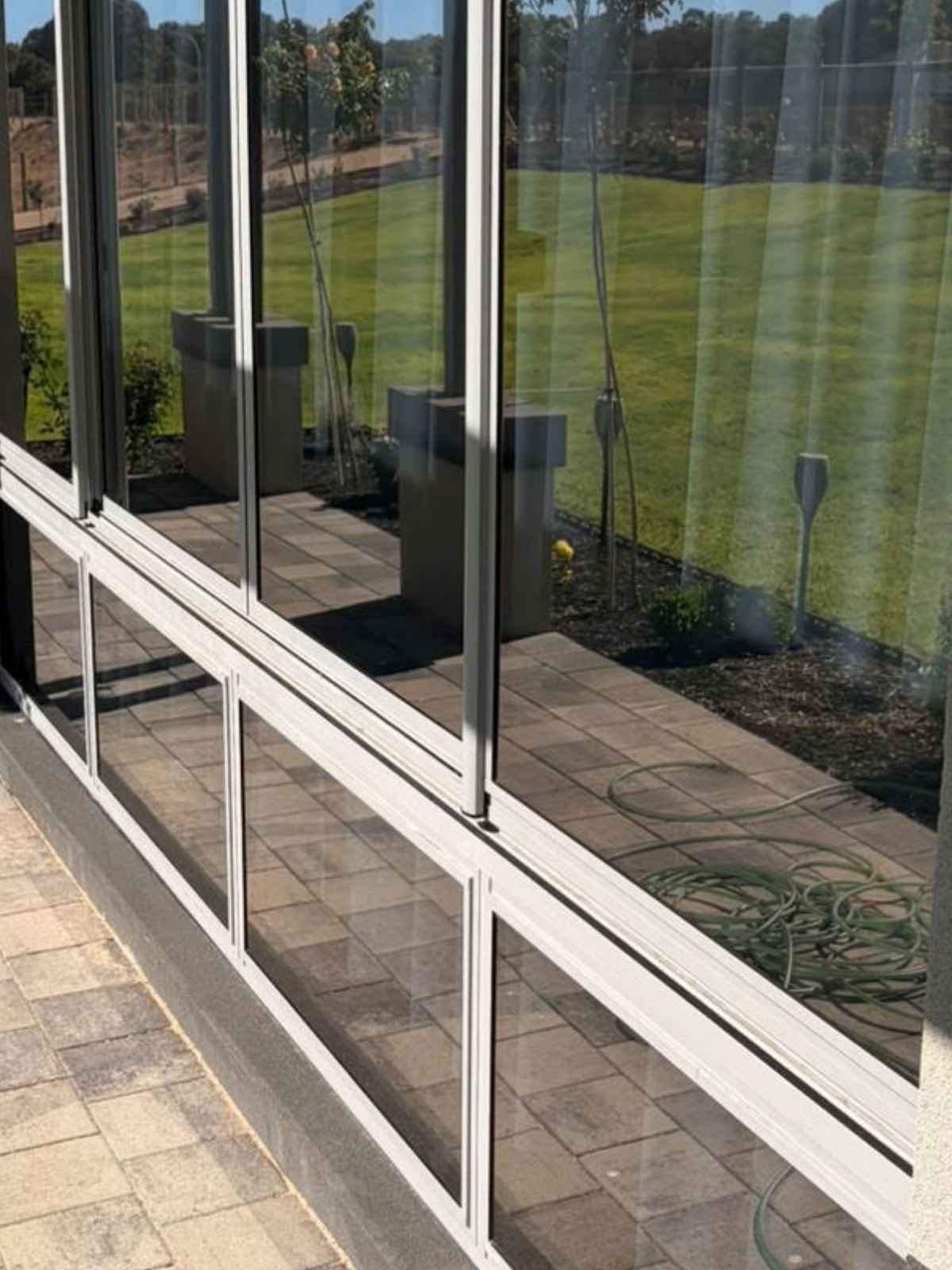
The after photo shows the same windows following our clean. Floor-to-ceiling glass, multiple panels across the full width of the alfresco-facing wall, completely clear — sharp reflections of the garden, the sky, and the surrounding landscape visible across every pane.
Here’s what was involved.
What We Were Looking At: The Before
The property featured a contemporary home with an expansive window wall running the width of what appeared to be the main living area, opening onto a paved alfresco and garden. The windows were large-format aluminium-framed panes — two rows of panels stacked vertically, floor-to-ceiling in height. The kind of window configuration that’s become common in newer Port Kennedy builds, designed to bring the outdoor garden view directly into the living space.
In the before photos, those views were completely obscured.
The mineral spotting was severe and uniform. Across all three close-up shots, the glass surface is covered in a dense, cratered pattern of individual white deposits — the characteristic texture of repeated water evaporation leaving dissolved minerals behind. Each deposit is a ring or blob of calcium carbonate, magnesium, or silica that has bonded to the glass surface. In the close-up, you can see the individual spots clearly. Standing back and looking at the full window, the cumulative effect is a glass surface that reads as frosted or sandblasted — the view through it reduced to vague shapes and colour.
The contamination was present on both the upper and lower panel rows. This rules out simple splash contamination from ground-level reticulation. The upper panels had been reached by windborne deposits, overspray carried upward in the air, and the long-cycle buildup of atmospheric minerals settling on the glass over an extended period.
The frames and sill sections were also carrying mineral residue. In the wide before shot, the grey aluminium framing shows a visible white coating of the same mineral deposits, particularly across the horizontal sill between the upper and lower window rows.
Why Port Kennedy Windows Get Hit This Hard
Port Kennedy is one of the suburbs in Perth’s southern corridor where we consistently see the most severe mineral spotting on glass. The combination of factors here is particularly aggressive:
Direct coastal exposure. Port Kennedy sits directly on the coast, with many properties having minimal vegetation buffer between the home and the prevailing onshore winds. Salt aerosols from the Indian Ocean carry inland continuously — not in visible quantities, but in concentrations sufficient to deposit on glass surfaces and combine with other minerals to create the bonded contamination visible in these photos. The more coastally exposed the property, the faster it accumulates.
Bore water reticulation with elevated mineral content. The groundwater in this part of the Rockingham coastal strip is notably hard — elevated in calcium, magnesium, and in some bores, iron. Reticulation systems drawing from local bores spray this mineral-laden water across garden beds and paving, and a proportion of that spray reaches the glass. Each wet-dry cycle deposits another thin layer of minerals on the surface. Over months, those layers stack up into the dense spotting visible in these photos.
Large glass surfaces with no overhang protection. The window configuration on this property — full-height panels with minimal architectural overhang — means the glass is fully exposed to both direct weather and reticulation overspray with no shelter. Homes with deep eaves or covered verandahs experience slower glass contamination for this reason. Open-facade designs, while visually striking, carry a higher maintenance requirement for the glass.
We see the same pattern of contamination in nearby coastal suburbs — Safety Bay, Shoalwater, Secret Harbour, and Warnbro all present similar mineral spotting challenges, particularly on properties with bore-fed reticulation and coastal aspect.
Why This Contamination Can’t Be Removed with Standard Cleaning
This is worth being direct about, because it’s a question we get regularly from homeowners who’ve tried to address mineral spotting themselves before calling us.
Standard glass cleaners — the kind available at any hardware store — are formulated for light surface contamination. They work by dissolving and lifting loose dirt, dust, and light smearing. They are not formulated to dissolve bonded calcium and silica deposits, because those deposits require a different chemical approach entirely.
Calcium carbonate and silica scale bond chemically to the glass surface over time. They’re not sitting on top of the glass — they’re effectively fused to it at a microscopic level. Wiping with a cloth and a standard cleaner typically spreads the contamination and adds new smearing on top of the existing deposits, which is why DIY attempts at this level of mineral spotting often leave the glass looking worse than before.
Professional removal requires an acidic treatment specifically formulated to break the chemical bond between the mineral deposits and the glass substrate. This needs to be applied carefully, at the right concentration, with appropriate dwell time, and then fully neutralised and removed before the final clean — because leaving acidic residue on glass or frames creates its own set of problems.
This is not a DIY job at this contamination level. It’s one of the clearest cases where professional treatment produces a result that simply isn’t achievable with household products.
How We Approached the Clean
Given the density and extent of the mineral spotting, this job required a staged treatment process rather than a standard wash-and-squeegee approach.
Stage 1 — Assessment and frame protection. Before any treatment, we assessed the spotting density across each panel and prepared the surrounding surfaces. The aluminium framing and any adjacent render or paintwork is protected during the treatment stage — professional-grade mineral removal solutions need to be kept off non-glass surfaces.
Stage 2 — Mineral treatment application. A professional acidic descaling solution was applied across the contaminated glass, working in manageable sections. The solution was allowed appropriate dwell time to break down the bonded deposits without etching the glass surface — the concentration and timing matters here, which is why this step requires experience rather than simply applying the strongest available product.
Stage 3 — Agitation and removal. The loosened mineral deposits were worked off the glass using professional pads and tools, then thoroughly rinsed from the surface. This stage often needs to be repeated on panels with the heaviest contamination.
Stage 4 — Full neutralisation and rinse. After treatment, the glass is completely neutralised and rinsed to remove all traces of the descaling solution. Skipping or rushing this step can leave a residue that attracts new contamination faster than untreated glass.
Stage 5 — Standard professional clean. Once the mineral deposits are removed, the glass goes through a full professional wash and squeegee using the S-pattern top-to-bottom technique — the same process used on every job. This final stage is what produces the streak-free, fully transparent result visible in the after photo.
Stage 6 — Frame and sill detailing. The aluminium framing and sill sections, which were also carrying mineral residue, were cleaned separately to restore the full appearance of the window installation.
The full process on a job of this scale and contamination level takes significantly longer than a standard maintenance clean — which is reflected in the result.
The After: What the Windows Look Like Now
The wide after shot shows the complete window wall following the clean. The transformation from the before close-ups is significant.
Where the glass had been covered in dense white spotting, it is now fully transparent. The reflections visible in the glass are sharp and detailed — the garden pavers, the manicured lawn, the surrounding trees and sky are all clearly reflected across every panel. The dark-tinted glass, which had been reading as almost opaque grey in the before shots, now shows its true character: highly reflective, deep, and clear.
From inside the property, the difference is even more dramatic. A window wall covered in mineral spotting reduces incoming light by a measurable amount and flattens the visual connection between the interior and the garden. Clean glass restores the full transparency that the design of the home was built around.
The aluminium frames have also come up cleanly, with the mineral coating removed and the dark grey colour restored uniformly across the full width of the installation.
Protecting the Glass After a Deep Clean
After a mineral treatment job like this, we always discuss maintenance with the homeowner. The glass is now clean and the deposits have been removed — but the conditions that caused the contamination haven’t changed. Bore water reticulation, coastal salt exposure, and the local climate will start working on the glass surface again immediately.
The practical approach is a regular maintenance schedule. Glass that’s professionally cleaned every six to twelve months doesn’t give mineral deposits the extended time needed to bond as deeply to the surface — which means future cleans are quicker, less intensive, and the glass never reaches the contamination level visible in these before photos again.
Some homeowners also adjust their reticulation timing to reduce overspray on glass — running systems in the early morning rather than during the heat of the day, for example, reduces the speed at which minerals deposit and dry on the surface.
Our broader guide on exterior maintenance scheduling for WA homeowners covers this in more detail for those planning ahead.
A Note on the Solar Panels
Port Kennedy’s coastal location makes it one of the areas where solar panel performance is most affected by salt and mineral contamination. If the windows on this property accumulated this level of mineral spotting, the rooftop solar panels will have been affected by the same deposit pattern — salt aerosol and bore water overspray don’t discriminate between glass surfaces.
We’ve covered the specific challenges facing Port Kennedy solar installations in our post on professional solar panel cleaning in Port Kennedy. The short version: coastal properties in this suburb can see significant generation losses from contamination, and our solar panel cleaning service uses a deionised water rinse system that removes deposits completely and leaves panels residue-free. Combining a window clean with a solar panel clean in a single visit is the most efficient approach.
Serving Port Kennedy and the Surrounding Coastal Suburbs
We cover Port Kennedy as part of our regular run along the Rockingham coastal strip. Nearby suburbs we regularly service include Safety Bay, Warnbro, Shoalwater, Secret Harbour, Rockingham, and Baldivis.
Exterior window cleaning starts from $99. For jobs involving heavy mineral spotting like this one, we’ll provide an accurate quote once we’ve assessed the contamination level on site. We’re also happy to combine window cleaning with solar panel cleaning, pressure washing, or gutter cleaning in a single visit.
Book a Window Clean in Port Kennedy
If your windows have mineral spotting — whether it’s as severe as this job or just the early stages of deposit buildup — it’s worth getting a quote before it gets worse. Visit our Port Kennedy service page for more information or to request a quote.
We service Port Kennedy and 30+ suburbs across Perth’s southern corridor.